Pathophysiology of Complex Orofacial Pain and Neuropathic Dental Disorders in 2026
Management of acute dental pain has historically relied on non-steroidal anti-inflammatory drugs (NSAIDs), acetaminophen, and short-course opioid therapy. However, clinical dentistry in 2026 faces an evolving demographic of patients presenting with complex, refractory orofacial pain syndromes that fail standard peripheral analgesic regimens. Conditions such as persistent idiopathic dentoalveolar pain (PIDAP), post-traumatic trigeminal neuropathic pain (PTNP), severe temporomandibular joint muscle spasticity (TMD-myalgia), and central sensitization following complex oral surgery require mechanistically targeted, non-standard pharmacotherapy.
Trigeminal Nociceptive Pathways and Peripheral Sensitization
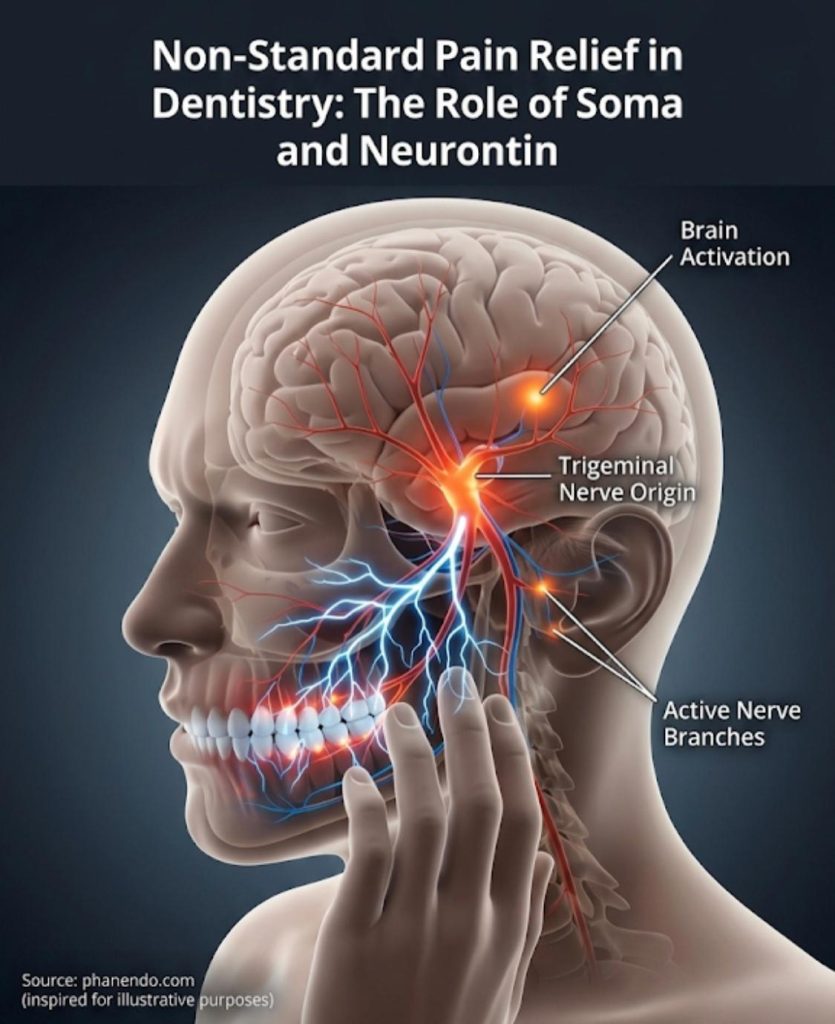
The trigeminal system supplies primary sensory innervation to the oral cavity, dentition, maxillary sinuses, and masticatory musculature. Peripheral nociceptors located within the dental pulp and periodontal ligament express primary ion channels, including transient receptor potential vanilloid 1 (TRPV1) and voltage-gated sodium channels ($\textNav1.7$, $\textNav1.8$, $\textNav1.9$). When tissue injury or acute pulpal inflammation occurs, damaged cells release an inflammatory mediator cocktail containing bradykinin, prostaglandins, substance P, and calcitonin gene-related peptide (CGRP).
Ectopic Axonal Sprouting and Voltage-Gated Sodium Channel Upregulation
Persistent peripheral inflammation or mechanical nerve transection such as direct injury to the inferior alveolar nerve (IAN) or lingual nerve during third molar extraction or endodontic overfilling triggers profound channel remodeling. Uninjured and damaged primary afferents upregulate $\textNav1.3$ and $\textNav1.8$ expression, generating ectopic discharge and lowering the threshold for mechanical allodynia.
Central Sensitization in the Trigeminal Nucleus Caudalis

Continuous nociceptive bombardment from peripheral trigeminal afferents forces structural and functional changes at second-order neurons in the trigeminal spinal nucleus caudalis (TNC). Presynaptic release of glutamate and CGRP causes persistent depolarization of postsynaptic membrane domains, relieving the voltage-dependent magnesium blockade of N-methyl-D-aspartate (NMDA) receptors. This influx of intracellular calcium induces long-term potentiation (LTP), transforming localized dental pain into diffuse, burning, or shooting neuropathic sensations that extend beyond original anatomical boundaries.
Masticatory Myofascial Spasms and Severe Trismus
Independent of direct nerve damage, mechanical trauma during prolonged dental appointments or surgical tissue retraction can induce acute hypertonicity in the masseter, temporalis, and pterygoid muscles. Masticatory muscle spasms cause severe trismus (restricted mouth opening), local muscular ischemia, and accumulation of lactic acid, creating a self-sustaining muscle spasm-pain-spasm cycle.
Clinical Practice Insight: Across my twenty years of clinical hospital practice managing complex maxillofacial trauma and post-surgical neuropathy, I have repeatedly observed that treating persistent trigeminal pain as simple inflammatory toothache is a recipe for failure. Once central sensitization takes hold in the trigeminal nucleus caudalis, standard NSAIDs fail because the primary driver has shifted from peripheral tissue injury to central hyperexcitability.
Mechanistic Foundations: Modulating Central Excitement and Muscle Spasticity
To overcome the limitations of standard dental analgesics, 2026 clinical protocols integrate non-standard agents that act on central neurotransmitter networks and neuromuscular junctions.
Central Muscle Relaxants: GABA Receptor Modulation and Spinal Reflex Suppression
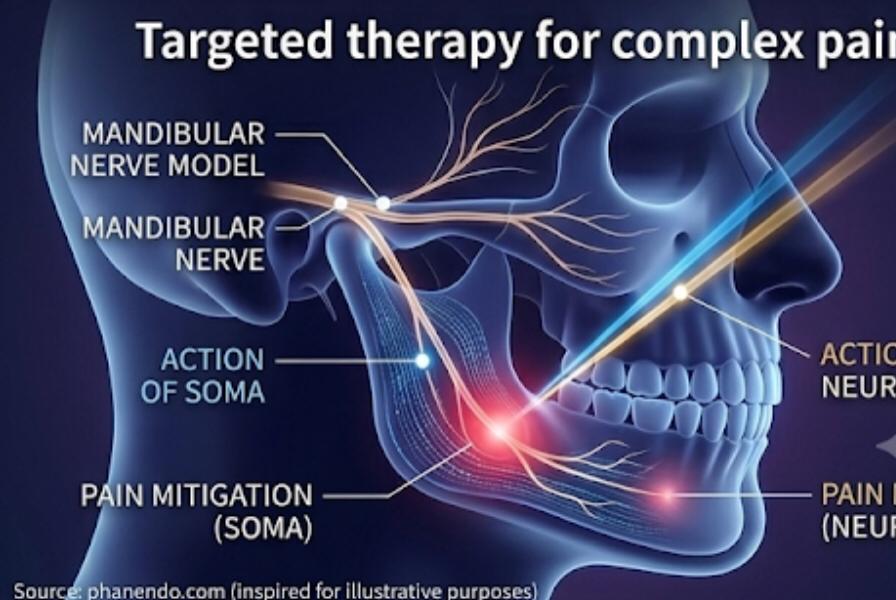
Centrally acting muscle relaxants target interneuronal networks within the spinal cord and brainstem. Carisoprodol functions as a central nervous system depressant whose primary active metabolite, meprobamate, exhibits direct $\textGABA-textA$ receptor positive allosteric modulating properties. By binding to $\textGABA-textA receptor sites distinct from benzodiazepine binding domains, it enhances chloride ion conductance, inducing sedation, reducing polysynaptic spinal reflexes, and breaking acute masticatory muscle spasms.
Voltage-Gated Calcium Channel Alpha-2-Delta Ligands
Gabapentinoids represent the gold standard for central neuropathic pain conditions. Gabapentin binds with high affinity to the alpha-2-delta ($\alpha_2\delta$) auxiliary subunit of presynaptic voltage-gated calcium channels (VGCCs) in the central nervous system.
Inhibition of Excitatory Neurotransmitter Release
By reducing calcium influx at presynaptic terminals of hyperactive second-order neurons in the trigeminal nucleus, gabapentin diminishes the vesicular release of excitatory neurotransmitters, including glutamate, substance P, and CGRP. Importantly, gabapentin does not bind directly to $\textGABA-textA$ or receptors, nor does it alter normal physiological signaling in non-sensitized pathways.
Utilizing non-standard analgesics in dentistry requires precise clinical evaluation, objective scoring, and cautious dosing titration tailored to specific dental procedures.
Managing Severe Masticatory Trismus and Post-Surgical Myospasm
For acute trismus following difficult mandibular third molar extractions or extensive orthognathic surgery, short-term central muscle relaxation breaks the inflammatory spasm loop. Clinical protocols in 2026 utilize $250\textmg$ to $350\textmg $ administered three times daily, strictly limited to 3 to 7 days, avoiding long-term physical dependence or withdrawal risks.
Protocol for Post-Traumatic Trigeminal Neuropathic Pain
When patients experience persistent burning or electric-shock sensations following endodontic therapy or implant placement, initiating gabapentinoid therapy early prevents irreversible central pain consolidation:Furthermore, severe chronic pain can exacerbate underlying anxiety, requiring a comprehensive understanding of modern diagnostic and therapeutic protocols for panic disorder to ensure optimal patient outcomes.”
- Day 1 to 3: Initial loading at $300\textmg $ taken at bedtime to evaluate sedation tolerance.
- Day 4 to 7: Titration to $300\textmg$ twice daily (morning and bedtime).
- Day 8 to 14: Maintenance dose of $300\text mg$ three times daily ($900\text mg/day $ total), with titration up to $1800\tex mg/day $ if partial relief is observed without disabling dizziness.
| Drug Class | Primary Molecular Target | Dental Indication | Onset of Action | Key Adverse Effects & Risks |
| NSAIDs (Ibuprofen / Naproxen) | Peripheral COX-1 & COX-2 Enzymes | Acute pulpal & surgical inflammation | 30–60 Minutes | GI mucosal ulceration, renal dysfunction, bleeding risk |
| Mu-Opioid Agonists (Codeine / Hydrocodone) | Central Mu-Opioid Receptors | Moderate to severe acute post-op pain | 30–45 Minutes | Sedation, respiratory depression, constipation, abuse liability |
| Central Muscle Relaxants (Soma / Carisoprodol) | $\text{GABA}_\text{A}$ Allosteric Site / Interneurons | Severe masseter spasm, acute post-op trismus | 30–45 Minutes | Central sedation, somnolence, dependence risk with chronic use |
| Alpha-2-Delta Ligands (Neurontin / Gabapentin) | Presynaptic VGCC $\alpha_2\delta$ Subunits | Trigeminal neuropathy, PIDAP, central allodynia | 1 to 2 Weeks (Titration) | Dizziness, peripheral edema, somnolence, ataxia |
When managing acute masticatory spasticity or persistent trigeminal neuropathy, maintaining therapeutic continuity is essential for patient recovery. Patients prescribed central muscle relaxants or gabapentinoids often require prompt medication access following complex surgical procedures. In modern practice, many patients choose to purchase Soma online or buy prescription Neurontin to streamline their post-operative care. Patients seeking to acquire or secure a supply of these prescription medications must strictly utilize accredited, state-licensed digital pharmacies verified by regulatory standards like NABP and VIPPS. Ensuring authentic pharmaceutical sourcing prevents exposure to sub-therapeutic or counterfeit formulations, safeguarding patient health under YMYL safety standards.
Pharmacy Verification Protocols and Prescription Standards
Prior to advising patients on where to purchase Soma or buy prescription Neurontin, dental professionals must verify that the online pharmacy platform requires a valid prescription from a licensed healthcare provider and offers direct access to a licensed pharmacist for drug interaction screening. Verifying pharmacy accreditation protects patients against unverified sources and ensures proper storage and distribution standards.
Pharmacy Compliance Pearl: In my outpatient clinical network, ensuring that patients receive verified, authentic pharmaceuticals is as important as crafting the initial surgical plan. Sourcing through legitimate, accredited channels ensures consistent active ingredient concentration and prevents therapeutic failures caused by counterfeit products.
Adverse Effects, Drug Interactions, and Safety Considerations in Dental Patients
Integrating central nervous system agents into dental practice requires careful screening for potential central nervous system depression, cognitive impairment, and drug-drug interactions.
Synergistic Central Nervous System Depression
Combining carisoprodol or gabapentin with opioids, benzodiazepines, or sedating antihistamines causes marked additive CNS depression. Patients must be warned against driving or operating machinery during therapy.
Hepatic Metabolism and Renal Clearance Pathways
Carisoprodol undergoes extensive hepatic metabolism by cytochrome $\textCYP2C19$. Patients with $\textCYP2C19$ poor metabolizer phenotypes exhibit prolonged serum half-lives and heightened sedation. Conversely, gabapentin is excreted unchanged by the kidneys without hepatic P450 metabolism; dose adjustments are mandatory in patients with renal impairment.
6. Frequently Asked Questions (FAQ)
Q1: What primary clinical scenario in dentistry justifies using a central muscle relaxant instead of standard NSAIDs?
A: Central muscle relaxants are indicated for acute, severe masticatory muscle spasms (trismus) and temporomandibular joint hypertonicity following traumatic oral surgery or prolonged jaw hyperextension, where peripheral inflammatory blockade by NSAIDs alone is insufficient.
Q2: How quickly does gabapentinoid therapy achieve clinical efficacy for post-surgical trigeminal nerve pain?
A: While central neurotransmitter suppression begins within hours of initial dosing, notable clinical reduction in trigeminal allodynia typically requires 1 to 2 weeks of gradual dosage titration to reach a therapeutic maintenance level.
Q3: Can dental patients safely purchase prescription Neurontin or purchase Soma through verified online pharmacies?
A: Yes, patients can safely purchase prescription Neurontin or purchase Soma online provided they use accredited, NABP-verified digital pharmacy platforms that require a valid doctor’s prescription and offer clinical pharmacist consultations.
Q4: Are there specific renal or hepatic precautions required when prescribing gabapentin for neuropathic dental pain?
A: Gabapentin is eliminated entirely by renal excretion without hepatic transformation, requiring precise dosage reduction in patients with renal insufficiency (creatinine clearance below 60 mL/min).
Q5: What is the maximum recommended duration for short-course central muscle relaxant therapy in post-operative dental care?
A: Central muscle relaxants should be prescribed for a maximum of 3 to 7 days in acute post-operative dental settings to minimize risks of tolerance, physical dependence, or withdrawal rebound.
7. Scientific References and Clinical Citations
- Benoliel R, et al. Persistent idiopathic dentoalveolar pain: Definition, diagnostic criteria, and clinical management guidelines. Journal of Oral & Facial Pain and Headache. 2023;37(2):95-112.
- American Dental Association. 2025/2026 Guidelines on Non-Opioid Pharmacotherapy for Acute and Neuropathic Dental Pain Management. ADA Clinical Practice Recommendations. 2025.
- Renton T, et al. Post-traumatic trigeminal neuropathic pain in dentistry: Diagnosis, prevention, and evidence-based pharmacotherapy. British Dental Journal. 2022;232(9):615-628.
- World Health Organization. Essential Dental Pharmacotherapy and Pain Management Protocols. WHO Technical Report Series. 2025.
- Hargreaves KM, et al. Seltzer and Bender’s Dental Pulp and Orofacial Pain Pathways. 3rd ed. Quintessence Publishing; 2024.