The US trade strategy is shifting significantly with the introduction of new generic drug tariffs. Aimed at boosting domestic manufacturing, this policy target imported pharmaceuticals to reduce reliance on foreign supply chains. Understanding the impact of these generic drug tariffs is essential for healthcare providers and pharmaceutical market analysis.
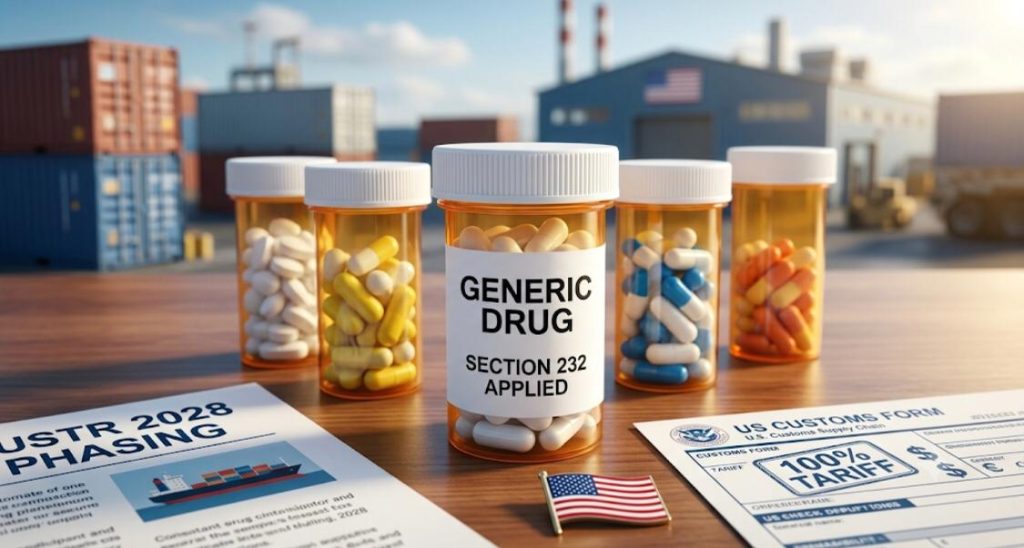
The Trump administration has expanded its “America First” trade policy to off-patent pharmaceuticals. Officials announced a phased tariff structure targeting imported generic drugs. The policy creates a two-year transition window ending in July 2028. After this period, imported generic medicines will face steep duties starting at 100%. These tariffs will rise to 200% in 2029.
Previously, the administration imposed tariffs on patented and branded pharmaceuticals. However, generic drugs remained exempt under Section 232 trade frameworks. Extending penalties to generic drugs marks a pivotal shift. Off-patent medicines account for more than 90% of US prescriptions. Therefore, they form the backbone of everyday healthcare delivery.
The Policy Architecture: A Two-Stage Penalty Structure
The policy sets a multiyear schedule for global drugmakers. This gives them time to build U.S. capacity before penalties take effect.”
Policy Mechanisms:
Two-Year Grace Period (0% Tariff): From August 1, 2026, to July 31, 2028, imported generic drugs remain duty-free. This period helps companies build U.S. facilities.Phase I Import Duty (100% Tariff): On August 1, 2028, imported generics face a 100% tariff. This penalty applies unless companies produce the drugs domestically.
Phase II Import Duty (200% Tariff): On August 1, 2029, the duty doubles to 200%. This high rate targets manufacturers that import finished generics from overseas plants.
- Market Reality: The Volume vs. Spend Paradox
- This policy generates intense debate across healthcare and trade sectors. To understand why, one must examine the key differences between generic and branded pharmaceuticals.
- Generic drugs rely on high sales volumes and slim profit margins. Therefore, even small cost increases disrupt product viability. For example, a generic pill may sell for just 10 cents. Imposing a 100% or 200% import tax drastically changes its market economics. This impact is far greater than a similar tariff on a $500 patented brand-name drug.
Global Supply Chain Interdependence
Over the past three decades, generic pharmaceutical supply chains have centralized around specialized international production hubs. Re-establishing this manufacturing capacity within the U.S. involves navigating complex global trade links:
The Role of India
India is the world’s largest exporter of generic finished medicines and the leading supplier to the U.S. market.
India exported $9.7 billion in pharmaceuticals to the U.S. in 2025, representing nearly 38% of its global drug exports.
Key chronic care treatments including maintenance medications for high blood pressure, type 2 diabetes, cholesterol. Bacterial infections are predominantly sourced from Indian facilities.
- The Upstream Reliance on China
Even when generic tablets or injectables are finished in India, North America, or Europe, the Active Pharmaceutical Ingredients (APIs). Key starting materials (KSMs) required to make them frequently originate in China. Up to 80% of APIs used by Indian generic manufacturers are supplied by Chinese chemical synthesis facilities. - Bilateral Trade Dynamics
The policy announcement has raised immediate questions among international trading partners:
The European Union: Trade representatives noted that generic drugs were explicitly exempted from tariffs under recent EU-US trade agreements, prompting European trade officials to seek clarification.
Canada: The Canadian Pharmaceutical Manufacturers . Exporters Alliance signaled that two years provides a strategic window to coordinate North American supply chain resilience rather than taking isolated action.
Operational Realities of Pharmaceutical Reshoring
Building advanced drug manufacturing facilities is a capital-intensive, multiyear effort. While the administration’s two-year timeline is designed to spur immediate action, industry experts highlight significant operational hurdles:
High Domestic Costs: Operating drug manufacturing plants in the U.S. involves significantly higher labor, environmental compliance, and facility overhead costs, which can be difficult to absorb for products selling at low price points.
Key Questions for Health Systems and Patients
As the August 2028 deadline approaches, healthcare providers, pharmacy chains, and policymakers are tracking several critical factors:
Will generic prices rise for consumers?
Generic drugs are substantially less expensive than branded alternatives, meaning that even if tariffs lead to price increases, generics will generally remain cheaper than patented drugs. However, patient advocacy groups warn that added costs on widely used maintenance drugs could raise out-of-pocket expenses for seniors and low-income patients.
Could tariffs worsen generic drug shortages?
Public health experts caution that because generic profit margins are so narrow, manufacturers faced with a 100% or 200% tariff might choose to stop supplying lower-margin products to the U.S. market altogether rather than build expensive domestic facilities, potentially compounding existing drug shortages.
Will the threat lead to trade concessions?
Analysts note that tariff threats often serve as bargaining leverage. Major multinational pharmaceutical firms may commit to U.S. facility investments, or foreign governments may seek bilateral trade agreements to secure lower rates or exemptions before 2028.
Looking Ahead to 2028
The administration’s generic drug tariff plan establishes a clear deadline for the global pharmaceutical industry. Between now and August 2028, drug manufacturers, global supply partners, and federal trade officials will navigate a changing market landscape. Whether the policy succeeds in shifting generic drug production back to the U.S. or creates cost and supply pressures will depend on how rapidly domestic manufacturing capacity can expand over the next two years.
Facility Construction Timelines: Establishing a new Food and Drug Administration (FDA) compliant manufacturing plant typically takes 3 to 5 years from site acquisition through cleanroom installation and equipment validation.
FDA Regulatory Approval: Beyond physical construction, manufacturers must produce regulatory validation batches and receive FDA bioequivalence and site inspection approvals before distributing drugs in the U.S.
Executive Summary
The introduction of a multi-year phase-in period (a two-to-four-year duty-free buffer) culminating in an escalating tariff (100%, rising to 200%) fundamentally alters the supply chain shock modeled in our previous analysis. While an overnight tariff would cause an immediate hard crash of the generic drug market, a phased announcement creates a highly volatile pre-implementation window.
By broadcasting a 200% future penalty, the policy essentially acts as an embargo with a delayed fuse. This scenario analysis models the unique economic distortions, market behaviors, and systemic risks that would occur between the announcement and the 2028 implementation date.
Phase 1: The Pre-Implementation Buffer (Years 0–2)
The announcement of a future 100%+ tariff would trigger immediate, massive market distortions long before the first tariff is collected.
1. The “Bullwhip Effect” and Artificial Shortages
Knowing that prices will effectively double or triple by 2028, the “Big Three” U.S. drug wholesalers (McKesson, Cencora, Cardinal Health), along with major pharmacy chains and hospital networks, would immediately begin hoarding generic drugs and active pharmaceutical ingredients (APIs).
- The Result: This massive, artificial spike in U.S. purchasing would drain global safety stocks. Ironically, the policy designed to secure U.S. supply would likely trigger acute, immediate drug shortages in the U.S. and globally, as current global manufacturing capacity cannot accommodate years’ worth of stockpiling demand all at once.
2. The Capital Market Frenzy
The two-to-four-year buffer is specifically intended to give U.S. industry time to build domestic capacity. We would see a historic influx of private equity and venture capital into U.S.-based Contract Development and Manufacturing Organizations (CDMOs).
- The Bottleneck: While capital can move instantly, concrete cannot. Building a cGMP (Current Good Manufacturing Practice) compliant API facility, securing EPA environmental permits for toxic chemical runoff, and passing FDA site inspections traditionally takes 3 to 5 years. The industry would be locked in a desperate race against the 2028 deadline, hampered by a severe shortage of specialized chemical engineers and regulatory consultants.
3. The Risk of Preemptive Retaliation
Foreign suppliers particularly in China and India, which dominate global API and generic finished dosage forms would not passively wait for the U.S. to build replacement capacity.
- Viewing the 200% tariff as a declaration of a pharmaceutical trade war, these nations might preemptively restrict the export of critical APIs or raw starting materials (RSMs) to the U.S., choosing to cut off supply before U.S. factories are online. This would turn a planned phase-in into an immediate crisis.
Phase 2: The 100% Tariff Implementation (August 2028)
By August 2028, domestic capacity will have expanded, but it is highly improbable that the U.S. could replace the 80% of generic volume currently imported from abroad within this timeframe.
1. The Bifurcated Market
The market would split into two tiers:
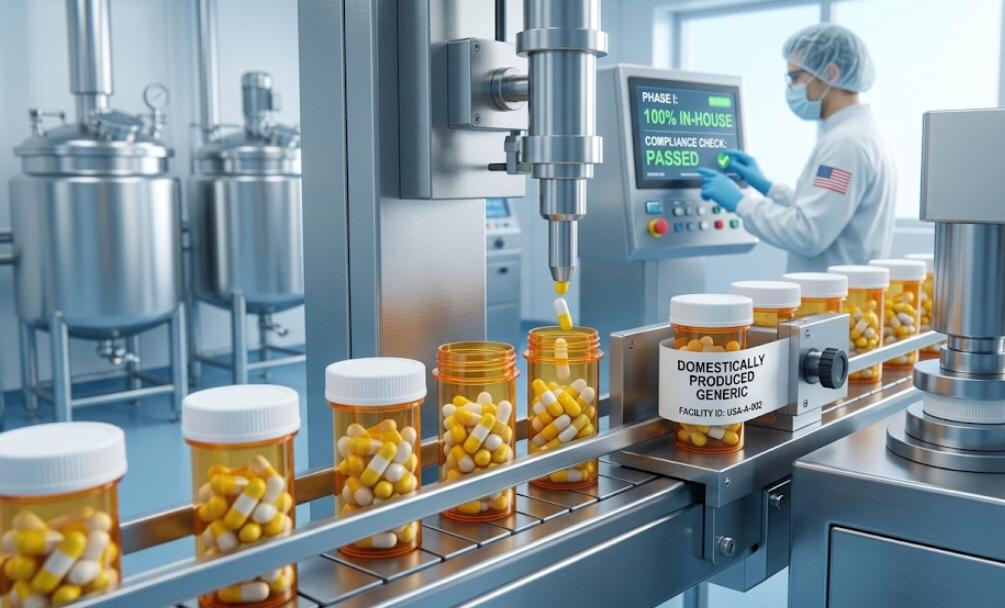
- Tier 1 (Domestically Produced): High-volume, highly critical generics (e.g., standard antibiotics, basic cardiovascular drugs) that received priority domestic investment. These will be available but significantly more expensive due to higher U.S. labor and compliance costs.
- Tier 2 (Imported & Tariffed): Lower-volume or highly complex generics that were not profitable enough to quickly reshore. These will be subjected to the 100% tariff.
2. The End of the “Penny Pill”
Because generic margins are so thin, a 100% tariff on Tier 2 drugs will be passed directly to the consumer and payers. PBMs (Pharmacy Benefit Managers), Medicare, and commercial insurers will see generic drug spending which historically acts as the deflationary anchor of the U.S. healthcare system spike dramatically. Patient premiums and deductibles will rise to absorb the cost.
Phase 3: The 200% Escalation and Market Decoupling (2030 and Beyond)
A 200% tariff is not a revenue-generating mechanism; it is a prohibitive barrier designed to force complete market decoupling. At this stage, importing generic drugs into the U.S. becomes economically unviable.
1. Complete Import Market Collapse
No generic drug can absorb a 200% tax and remain competitive. Any generic drug that has not been successfully reshored by this escalation point will effectively become unavailable in the United States.
2. The Innovation vs. Manufacturing Trade-off
To maintain this reshored ecosystem, the U.S. government will likely have to heavily subsidize domestic generic manufacturing indefinitely (through tax breaks, guaranteed government contracts, or sustained high consumer prices). This shifts national healthcare capital away from R&D (developing new cures) toward subsidizing the manufacturing of 40-year-old off-patent drugs.
3. Systemic Healthcare Inflation
The ultimate result of this scenario is a permanent structural increase in the cost of U.S. healthcare. While the policy achieves its stated goal shifting pharmaceutical production to the United States it does so by reversing the economic model of the generic drug industry. U.S. patients would have a highly secure supply chain, but the era of cheap, globally sourced generic medications would be permanently closed.
Long-Term Outlook for Patients and Healthcare
“These shifting trade policies directly impact the availability and affordability of essential prescriptions, including lifesaving antibiotics used to treat severe conditions. As pharmaceutical supply chains adapt to new duties, understanding how to manage common treatments becomes critical for patients; for a deeper look into proper medication use, explore our detailed guide on bacterial infections treatment strategies.
Ultimately, the strategic shift toward domestic manufacturing and new generic drug tariffs represents a major transition for the U.S. healthcare system. While these policies aim to strengthen supply chains and reduce reliance on overseas plants, the immediate focus remains on maintaining uninterrupted access to vital medications. Balancing national trade goals with affordable, high-quality patient care will be the key test for policymakers, manufacturers, and healthcare providers in the coming years.