
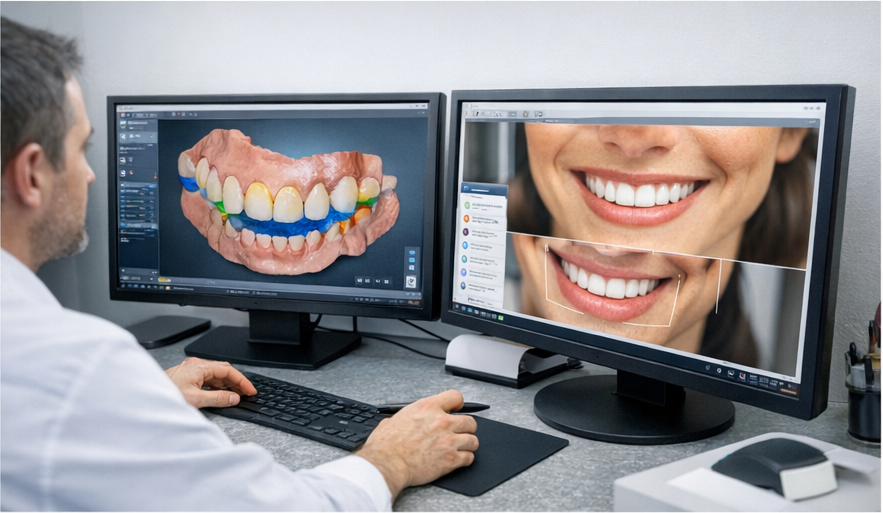
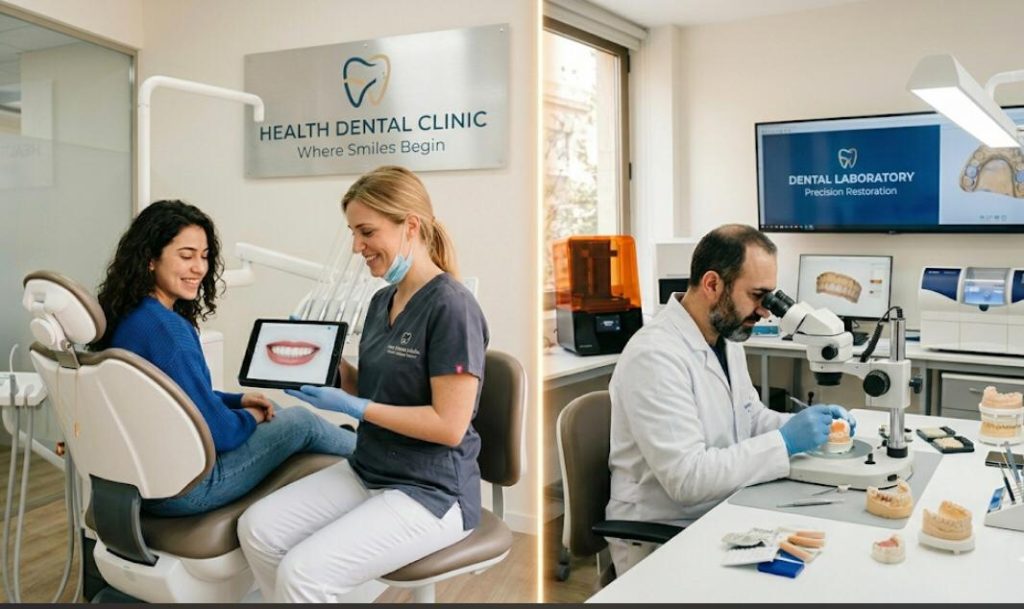
Cosmetic dentistry has changed from a mostly analog craft into a connected digital workflow. That does not mean artistry has disappeared. It means the artistic side of smile rehabilitation now works with better records, faster communication, more precise fabrication, and clearer patient previews. In practical terms, a modern dental laboratory can receive an intraoral scan in the morning, review facial photographs before lunch, return a digital wax-up the same day, print a mock-up overnight, and move a veneer, crown, or provisional case into production without ever handling a physical stone model. For practices that offer veneers, esthetic crowns, implant restorations, smile makeovers, or full-mouth rehabilitation, that flexibility can be a real competitive advantage.
The word “flexible” matters here. A digital lab is not valuable only because it owns software and milling units. It is valuable when it can adapt the workflow to the needs of the case, the clinician, and the patient. Some cosmetic cases need a fully digital path from scan to restoration. Others still benefit from a hybrid approach that combines digital planning with analog characterization, cut-back layering, or custom shade work. The best digital laboratories do not force every case through the same template. They use digital tools to improve planning, communication, and repeatability while preserving the clinical judgment and artistic detail that esthetic dentistry still depends on.
This matters even more in 2026 because search engines and AI-driven answer systems increasingly reward content that gives direct, structured, quotable answers. A vague article about “technology in dentistry” is not enough. Dental professionals and patients both want to know what these services actually do, how they change treatment, where they help, where they do not, and how to evaluate a lab before sending a cosmetic case.
What flexible digital laboratory services really mean
In cosmetic dentistry, flexible digital services usually refer to a menu of connected capabilities rather than one machine or one file type. A practice may send a case with intraoral scans only. Another may send scans, retracted photos, full-face portraits, shade references, and a short video of the smile in motion. A third may need implant planning data, CBCT information, or a request for provisional restorations first and final ceramics later. The laboratory has to translate those inputs into a usable, predictable workflow.
The American College of Prosthodontists notes that advanced digital technologies combine scanned data with imaging systems and use milling or additive manufacturing to produce restorations with predictable accuracy and fit. The same position statement also points to the value of open digital workflows that allow communication between scanners, CAD software, and manufacturing processes instead of trapping the case inside one closed ecosystem. That open, adaptable model is the core of real workflow flexibility.
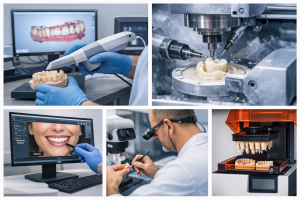
In day-to-day cosmetic work, flexible digital services often include:
- digital case intake and file review;
- intraoral scan acceptance from multiple scanner brands;
- digital smile design support;
- diagnostic wax-ups and virtual tooth libraries;
- 3D-printed mock-ups, prep guides, and reduction guides;
- CAD design for veneers, crowns, bridges, implant restorations, and provisionals;
- milling or 3D printing based on the selected material and indication;
- remote shade communication using calibrated photography and shade maps;
- revision cycles with annotated screenshots or live online collaboration;
- hybrid workflows that blend digital design with analog finishing or ceramic layering.
When those services are organized well, the lab becomes more than a manufacturer. It becomes a planning partner.
Why cosmetic dentistry is especially suited to digital collaboration
 Cosmetic cases are heavily visual, and that is one reason digital methods fit them so well. The clinician is not only replacing tooth structure. The clinician is managing facial proportions, incisal edge position, smile line, translucency, texture, symmetry, phonetics, and patient expectations. Traditional impressions and paper prescriptions can support that work, but they do not capture the whole esthetic story very efficiently. Digital photography, facial scans, intraoral scans, mock-ups, and annotated design files make the conversation much clearer.
Recent literature on Digital Smile Design has reinforced this point. A 2025 systematic review reported that DSD-guided esthetic restorative treatment was consistently associated with better patient-centered outcomes, including stronger satisfaction, improved esthetic perception, and better communication during treatment planning. That is not a small detail. Cosmetic treatment succeeds partly because the restoration looks good, but also because the patient feels involved, informed, and confident before irreversible steps begin.
Digital workflows also support minimally invasive treatment planning. When clinicians and technicians can compare the existing dentition with a proposed final shape on screen, they can often plan reductions more carefully, preserve enamel more intentionally, and build reduction guides that prevent unnecessary preparation. A 2026 Frontiers case report on Digital Smile Design-driven lithium disilicate veneers described exactly that logic: digital planning, mock-up approval, silicone guides, and conservative preparation designed to balance esthetics with tissue preservation.
The main digital services a cosmetic dental lab can offer
1. Scan-ready case intake
The first layer of flexibility is simple but important: the lab must accept files from different intraoral scanners and know how to evaluate them. Not every scan is immediately usable. Margin capture, emergence profile definition, tissue displacement, occlusal records, interproximal clarity, and bite alignment all affect the result. A strong digital lab does not just download files and start designing. It reviews data quality, flags missing information early, and tells the practice whether the case is ready or needs rescanning.
That review step saves time. ADA reporting has shown that dentists who use intraoral scanners frequently cite better outcomes and improved efficiency, while satisfaction among users is high. More recent review literature also links intraoral scanners with procedural simplification, time efficiency, and high patient satisfaction. Still, scanners are not magic wands. If the scan is incomplete, the digital workflow only makes the problem move faster.
2. Digital smile design and esthetic planning support
For veneer cases, esthetic crown length changes, diastema closure, or broader smile-makeover work, the lab may help convert photographs and scans into a planned destination. This can include midline analysis, tooth proportion review, gingival reference evaluation, incisal edge proposals, and virtual simulations. The goal is not to let software replace diagnosis. The goal is to give the dentist and patient a visual planning language.
The best labs do this with restraint. A smile design should guide treatment, not trap it. A rendered image may look attractive on a screen but still fail biologically or functionally if it ignores occlusion, periodontal realities, phonetics, or preparation limits. That is why experienced digital dental labs usually treat smile design as a communication tool tied to records, provisional testing, and clinician feedback, not as a promise that every pixel will translate directly into ceramic.
3. Diagnostic wax-ups and printed mock-ups
One of the most useful services in cosmetic dentistry is the rapid creation of a digital wax-up followed by a printed model or chairside mock-up. This turns an abstract discussion into something the patient can see and, in many cases, try in. It also lets the clinician evaluate lip support, length, contour, speech, and occlusal space before final preparation.
Mock-ups are where flexibility becomes tangible. Some practices want a same-day digital preview only. Others want a full printed model with reduction guides. Others need a provisional matrix for an injection-molding composite approach before ceramic treatment. A capable lab can support all of those paths without starting from scratch each time.
4. CAD design for veneers, crowns, implants, and combination cases
Cosmetic work rarely stays inside one simple category. A patient may need six anterior veneers, two implant crowns, one full-coverage crown on a dark tooth, and provisional restorations that test vertical dimension before the final ceramics are made. Flexible digital labs can manage mixed-indication cases within one planning environment. They can design around material thickness, emergence profile, connector strength, implant position, and esthetic symmetry at the same time.
This is where digital design earns its keep. The technician can compare contours across multiple units, mirror reference anatomy, evaluate path of insertion, and create repeatable provisional-to-final transitions. When a practice needs a revision, the digital file preserves the logic of the design, making controlled changes easier than rebuilding the case from zero.
5. Milling and 3D printing matched to the indication
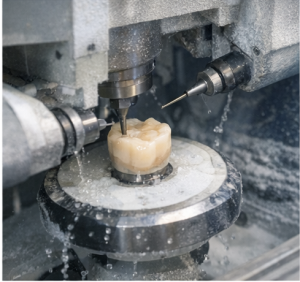
There is no single “best” manufacturing method for every cosmetic case. Milling remains central for many ceramic restorations, especially where material properties and proven workflows are well established. Additive manufacturing is expanding fast, especially for mock-ups, models, guides, provisionals, dentures, and selected definitive restorations depending on material clearance and case selection.
That distinction matters. FDA-cleared materials now include 3D-printable resins intended for permanent restorations such as veneers, crowns, inlays, onlays, and bridges in validated workflows. At the same time, the material choice still has to match the indication. A 2025 Journal of Dentistry study found that subtractive lithium disilicate, subtractive zirconia, and high-performance additive zirconia all showed clinically acceptable adaptation and retention for laminate veneers in vitro, while printed resin composite performed worse and was better limited to provisional use. In other words, digital speed is useful, but material science still calls the shots.
6. Provisional and trial restorations
Provisionals are not just placeholders in cosmetic dentistry. They are a diagnostic phase. A digital lab can duplicate approved contours, adjust incisal position, print matrices, fabricate long-term provisionals, and create a more controlled transition from test smile to final ceramics. That is valuable in complex esthetic cases because the final result should feel like a refined version of something already validated, not a surprise reveal with crossed fingers.
7. Shade communication and surface characterization support
Even in a highly digital workflow, shade remains part science and part art. Good labs now work with high-resolution photographs, cross-polarized images, stump shade references, shade tabs, and annotated maps that show value, translucency zones, incisal halo, craze lines, or localized chroma. Some cases can be completed in a mostly monolithic way. Others require cut-back and layering to avoid that flat, over-milled look that patients may notice even if they cannot name it.
This is one of the biggest myths in digital dentistry: that digital means standardized, and standardized means esthetic. It does not. A digitally designed veneer can still look lifeless if texture, line angles, and light behavior are handled poorly. Flexible digital service means the lab can start with CAD efficiency and finish with human nuance.
How digital lab flexibility helps the dental practice
From the practice side, flexibility improves more than turnaround time. It can reduce remakes, compress communication loops, and make scheduling more predictable. When a lab can review records immediately, send screenshots of margin concerns, and return a wax-up before the prep appointment, the practice spends less time improvising. That can be especially useful for fee-for-service cosmetic cases where the patient expects premium organization, not just premium ceramics.
There is also a branding advantage. Patients increasingly understand before-and-after previews, digital planning, and mock-up try-ins. They may not know what STL files are, but they recognize a more modern process when they see one. Used correctly, digital collaboration can support trust because the patient sees a progression: records, design, trial phase, revisions, then final delivery.
None of that means every case becomes faster. Sometimes the flexible option is to slow down. A difficult esthetic case may need a longer provisional phase, a second smile-design review, or analog surface characterization after a digital design is milled. Real flexibility means the lab can move quickly when speed makes sense and deliberately when detail matters more.
Data management, turnaround, and version control
Another overlooked advantage of a flexible digital lab is administrative control. Cosmetic cases generate many assets: scans, face photos, bite records, design files, screenshots, provisional revisions, and approved final versions. If those records are organized well, the practice can revisit a case months later and understand exactly what changed, what the patient approved, and which file produced the final restoration. That is useful for remakes, additions, repairs, and phased treatment plans.
Digital organization also improves turnaround management. A lab can stage the case more intelligently, separating urgent provisional needs from definitive ceramic work, or holding manufacturing until the patient approves a mock-up. Just as important, version control prevents the classic esthetic disaster where one team member is looking at an old design while another is building the new one. Flexible service, in this sense, is not only technical. It is operational. It means the lab can keep complex cosmetic treatment moving without losing the thread.
Where the limits still are
Digital dentistry is powerful, but it is not frictionless. File compatibility still matters. The ACP has long pointed out that proprietary systems can reduce interoperability and limit choices. Some practices also overestimate what AI or automated design can safely do. A 2025 review on generative AI in dentistry reported promise in crown design and tooth alignment, but it also emphasized the lack of clinical validation, fragmented workflows, non-standardized datasets, and privacy and transparency concerns. That is a good reality check. Software can accelerate parts of design, but it should not replace clinical accountability.
Training is another limit. A laboratory can only be as good as the data it receives and the people interpreting it. If the practice has poor scan protocols, weak photography, or unclear prescriptions, digital files do not solve the problem. Likewise, if the lab runs every case through default settings without understanding occlusion, facially driven planning, or material behavior, the result can look mechanical and generic. Cosmetic dentistry punishes generic work.
Cost is a third limit. Scanner adoption has grown, but cost remains a barrier for some offices. The ADA has reported that financial investment is still the top reason many nonusers have not introduced intraoral scanning. For some practices, a hybrid model remains the smart choice: use conventional steps where needed, and use digital services where they provide the clearest benefit.
How to evaluate a digital dental laboratory for cosmetic cases
Not every “digital lab” is equally useful for esthetic dentistry. Some are excellent at routine crown-and-bridge production but weaker at facially driven smile design. Others are fast with printing but limited in ceramic characterization. A practice that wants premium cosmetic outcomes should ask practical questions before outsourcing important cases.
- Can the lab accept files from your scanner and preferred software ecosystem?
- Does it review records proactively and request rescans early when needed?
- Can it provide digital wax-ups, mock-ups, and reduction guides for veneer cases?
- How does it handle shade communication for high-esthetic cases?
- Which materials does it recommend for veneers, full-coverage anterior crowns, provisionals, and implant esthetic zones?
- Can it support hybrid workflows when analog finishing is the better choice?
- How are design revisions documented and approved?
- What is the remake policy, and how often are remakes related to data quality versus manufacturing?
If the answers are vague, that is useful information. Cosmetic dentistry needs clarity early, not surprises on insertion day.
What patients should understand
Patients often hear phrases like “digital smile design,” “same-day dentistry,” or “3D-printed veneers” and assume the technology guarantees a perfect outcome. It does not. Good cosmetic results still depend on diagnosis, case selection, tissue health, preparation design, material choice, bite management, and careful cementation. The digital lab supports that chain. It does not replace it.
At the same time, patients can benefit from digital workflows in very practical ways. Scanning is often more comfortable than traditional impressions. Previews can reduce uncertainty. Mock-ups can make it easier to approve shape and length before final treatment. In many cases, the process is more transparent because the patient sees the plan develop instead of waiting for a mysterious package from the lab.
FAQ
Are digital dental lab services only for veneers?
No. They are widely used for veneers, esthetic crowns, implant restorations, mock-ups, provisionals, surgical guides, and complex rehabilitations that combine several restoration types.
Do digital workflows always improve esthetic outcomes?
Not automatically. They improve the odds of better communication, planning, and reproducibility, but the final esthetic result still depends on clinical judgment, technician skill, and material selection.
Can 3D printing replace ceramic work in cosmetic dentistry?
It can support many parts of the workflow and some definitive restorations, but not every printed material is ideal for every indication. Case selection and validated material protocols remain essential.
Is digital smile design the same thing as treatment planning?
No. It is one part of treatment planning. It helps visualize esthetic goals, but it must be checked against function, biology, occlusion, and restorative limitations.
Are flexible digital services better than a fully closed system?
Often, yes, especially when a practice wants freedom to use different scanners, software, materials, and manufacturing options. Open workflows can reduce lock-in and widen clinical choices.
Conclusion
Flexible digital services in the dental laboratory are not just about faster files and newer machines. In cosmetic dentistry, their real value is the ability to connect diagnosis, design, communication, provisional testing, and final fabrication in a way that stays adaptable to the case. That flexibility supports clearer planning, stronger patient communication, more consistent revisions, and better coordination between dentist and technician.
Still, digital should not be confused with automatic. The most successful cosmetic workflows combine accurate records, disciplined clinical protocols, intelligent material selection, and laboratory artistry. When those pieces align, digital services do something very useful: they make beautiful work more predictable without turning it into factory work. That is the balance modern cosmetic dentistry needs.
Research basis used for accuracy review
- American College of Prosthodontists. Position Statement: Digital Dentistry: Use of Advanced Digital Technologies.
- American Dental Association. ACE Panel report finds about half of dentists use intraoral scanners. 2021.
- American Dental Association. Digital dentistry: What to know about a few popular technologies. 2022.
- Lee Y, Ku H, Jun M. Clinical Application of Intraoral Scanners in Dentistry: A Narrative Review. Oral. 2024.
- Alwabel LK et al. Digital Smile Design and Patient-Centered Outcomes in Esthetic Restorative Dentistry: A Systematic Review. 2025.
- Dang AT et al. Digital smile design-driven minimally invasive lithium disilicate laminate veneers in the aesthetic zone: a 6-year follow-up case report. Frontiers in Dental Medicine. 2026.
- FDA 510(k) summaries for printable restorative materials including Aidite, Saremco, and BEGO restorative indications for crowns, veneers, inlays, and onlays in validated workflows.
- Sasany R, Cakmak G, Mosaddad SA. Accuracy and retention of laminate veneers made from zirconia, resin composite, and lithium disilicate using additive and subtractive techniques. Journal of Dentistry. 2025
The best part here is the emphasis on communication between dentist, technician, and patient. That is where many esthetic cases fail.
This is a strong overview for dentists who want to modernize lab communication without overcomplicating their cases.
Gum Disease, Dental Implants.
Good article for anyone who wants a grounded view of digital dentistry without the usual marketing noise.
Predictability is the real value here. Cosmetic dentistry gets easier when everyone sees the same plan before prep begins.
I found the section on evaluating a digital lab especially useful. The right questions save a lot of frustration later.
Great point about version control. Cosmetic cases can get messy fast when multiple design revisions are floating around.
The point about mock-ups being a diagnostic phase, not just a preview, is exactly why digital workflows can be so valuable.
Digital workflows really do make provisional planning easier when the lab is organized and responsive.
Helpful breakdown of why flexibility matters more than pure speed in cosmetic dentistry.
The comments on shade communication are spot on. A digital file alone does not create lifelike ceramics.
Hello! Your energy is contagious!
https://surl.li/wmuvys
The article offers a realistic view of how digital workflows facilitate the planning of minimally invasive veneers.
This was a smart reminder that some cases should stay hybrid instead of going fully digital just because the tools exist.
This really highlights how important it is for dental labs to stay up to date with digital advancements.
The shift toward digital workflows is clearly improving both turnaround times and patient satisfaction.
Flexible digital solutions are exactly what modern cosmetic dentistry needs—efficiency without sacrificing quality.
Really appreciate this perspective. Digital services are opening up new possibilities that weren’t even imaginable a few years ago.
Great insights! It’s amazing to see how technology is helping dental labs deliver faster and more consistent results. The level of customization you can achieve with digital tools today is incredible. Patients definitely benefit from this kind of innovation.
I love how digital services are making collaboration between dentists and labs so much smoother and more precise.
This is such an interesting look at how digital workflows are transforming cosmetic dentistry. The flexibility really seems like a game changer for labs.
Adopting a flexible digital infrastructure is no longer optional for labs focusing on cosmetic excellence. These services provide the modularity needed to incorporate the latest biocompatible materials and scanning technologies seamlessly. By staying adaptable, we can offer diverse solutions ranging from ultra-thin laminates to complex implant-supported bridges without losing the “human touch.” It is an exciting era where technology serves as the ultimate paintbrush for the modern dental technician’s artistic vision and technical skill.
Flexible digital services are transforming cosmetic dentistry by enabling dental laboratories to deliver highly customized restorations with speed and precision. Cloud-based workflows, CAD/CAM integration, and real-time collaboration between clinicians and technicians ensure consistent quality while adapting quickly to patient-specific aesthetic demands. You can read more about this on my blog https://medium.com/@digitalhealthmeds
This synergy between technician expertise and versatile software ensures that every porcelain veneer or crown is a unique masterpiece. It is no longer just about speed; it is about achieving that perfect, lifelike aesthetic that patients demand in modern restorative dentistry.
Research increasingly supports what many people experience personally: poor dental health contributes significantly to anxiety and depression. Constant oral pain triggers the body’s stress response, disrupting mental equilibrium over time. Additionally, the financial burden of dental treatment creates its own psychological strain. Addressing dental problems promptly should be considered an essential component of comprehensive mental healthcare.